
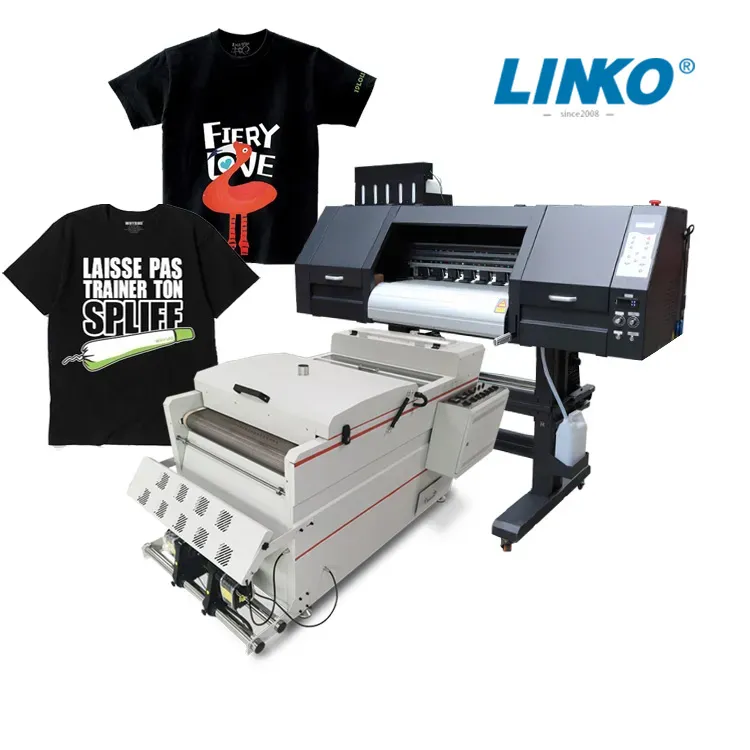
A DTF printer (direct-to-film printer) is an inkjet printer that prints a design in CMYK ink plus a layer of white ink onto PET film. Hot-melt adhesive powder is applied to the wet ink and cured, and the finished transfer is heat-pressed onto fabric. DTF transfers can be applied to cotton, polyester and cotton-poly blends, on light and dark garments, without pretreatment.
This guide explains how DTF printing works, what equipment a DTF setup needs, how DTF compares with DTG, sublimation and screen printing, and how to choose a DTF printer by print width, printhead and output. LINKO is a DTF printer manufacturer producing 180–200 printers per month.

How Does DTF Printing Work?
- Prepare the artwork. The design is processed in RIP software (for example PrintFactory or Maintop). The RIP mirrors the image, applies the color profile and generates the white ink layer.
- Print on film. The printer prints the CMYK image and then a white layer on top of it onto PET film.
- Apply powder. While the ink is still wet, hot-melt adhesive powder is spread over the print and the excess is shaken off. Production setups use an automatic powder shaker.
- Cure. The film passes through a dryer or oven that melts the powder into an adhesive layer.
- Heat press. The transfer is pressed onto the garment, then the film is peeled off hot or cold depending on the film type. Temperature, time and pressure depend on the film, powder and fabric; see DTF heat press settings.
What Equipment Does a DTF Setup Need?
| Item | Function | Notes |
|---|---|---|
| DTF printer | Prints CMYK and white ink on PET film | Common widths: A3 (about 30–35 cm) and 24 inch (60 cm) |
| Powder shaker and dryer | Applies and cures the adhesive powder | Inline with 24 inch roll printers; manual powdering and a separate oven are common with A3 printers |
| DTF ink | Pigment ink, CMYK plus white | White ink settles, so printers use white ink circulation or stirring |
| DTF film | PET carrier film for the print | Hot peel or cold peel |
| DTF powder | Hot-melt adhesive that bonds the print to fabric | White or black, in different grain sizes |
| Heat press | Transfers the print onto the garment | Flat press for garments; cap press for hats |
| RIP software | Color management and white layer control | PrintFactory, Maintop |
DTF vs DTG vs Sublimation vs Screen Printing
| Method | Fabrics | Garment colors | Pretreatment | Typical order size |
|---|---|---|---|---|
| DTF | Cotton, polyester, blends | Light and dark | Not needed | Single pieces to bulk orders |
| DTG | Cotton and high-cotton blends | Light and dark | Needed for dark garments | Single pieces and short runs |
| Sublimation | Polyester or polyester-coated items | White and light | Not needed | Single pieces to bulk orders |
| Screen printing | Most fabrics | Light and dark | Not needed | Bulk orders; one screen per color |
More detail: DTG vs DTF and DTF printing vs sublimation printing.
How to Choose a DTF Printer
1. Print width
A3 printers (about 30–35 cm, 12–13.9 inch) suit startups, sampling and small orders. 24 inch (60 cm) roll printers suit print shops and transfer suppliers that print gang sheets in volume. See A3 vs A4 DTF printers.
2. Printhead model and number of heads
Common DTF printheads are Epson XP600, i1600 and i3200. At the same pass setting, more printheads give higher output. For example, the LINKO K-60 prints 9, 15 or 24 m²/h in 6-pass mode with 2, 4 or 5 Epson i3200-A1 heads. See XP600 vs i3200 printheads.
3. Ink configuration
The standard configuration is CMYK + white (4+1). Some printers offer additional colors; the K-60 is available in 8+1 (CMYK + white + red, blue, green, orange).
4. Powder shaker and dryer
For roll printing, an inline powder shaker with a dryer applies and cures powder automatically. Check that the shaker width matches the printer width.
5. Software, spare parts and support
Check whether the RIP software license is included and permanent, whether spare parts and printheads are available, and what installation and remote support the manufacturer provides.
6. Total cost
Budget for the printer, powder shaker, heat press, and running cost per square meter (ink, film, powder). See how much a DTF printer costs and how beginners choose a DTF printer.
LINKO DTF Printer Models
| Model | Print width | Printheads | Ink colors | Print speed | Powder shaker |
|---|---|---|---|---|---|
| L402 | A3, 354 mm (13.9 in) | 2 × Epson i1600 | CMYK + W | 8-pass 3 m²/h; 12-pass 2 m²/h | Separate |
| A-602 | 600 mm (24 in) | 2 × Epson i3200-A1 | CMYK + W, or CMYK + W + red, blue, green, orange | 4-pass 10–15 m²/h; 6-pass 5–10 m²/h | Included in bundle |
| K-60 | 600 mm (24 in) | 2, 4 or 5 × Epson i3200-A1 | CMYK + W, or CMYK + W + red, blue, green, orange | 6-pass 9 / 15 / 24 m²/h (2 / 4 / 5 heads) | Optional |
LINKO K-60 DTF Printer: 2, 4 or 5 Epson i3200 Printheads
The K-60 has a 60 cm (24 inch) print width and is available as K-602, K-604 and K-605 with 2, 4 or 5 Epson i3200-A1 printheads. The number of printheads is chosen when ordering. Ink configuration is 4+1 or 8+1, and a powder shaker and dryer are available on request. RIP software: PrintFactory.

LINKO L402 A3 DTF Printer: Dual Epson i1600
The L402 is an A3 roll DTF printer with a 354 mm print width and two Epson i1600 printheads. It prints CMYK + white at 3 m²/h (8-pass) and connects via Gigabit Ethernet.

View LINKO L402 A3 DTF Printer
LINKO A-602 24 Inch DTF Printer Bundle
The A-602 bundle includes a 24 inch DTF printer with 2 Epson i3200-A1 printheads, a 24 inch powder shaker, an oven, a filter, DTF ink, DTF film, DTF powder, RIP software, installation videos and one-to-one training.

View LINKO A-602 DTF Printer Bundle
What Can You Print with a DTF Printer?

- Custom T-shirts and hoodies: single pieces and short runs, including full-color designs on dark garments.
- Sportswear and team uniforms: names, numbers and logos on polyester jerseys.
- Workwear and promotional apparel: company logos on polos, jackets and vests.
- Accessories: caps, tote bags and other fabric items that fit a heat press.
For hard surfaces such as cups, bottles and phone cases, UV DTF printers are used instead of DTF. For transfer placement and sizes, see the DTF transfer placement guide.
DTF Printer FAQ
What does DTF stand for?
DTF stands for direct-to-film. The design is printed onto PET film first and then transferred to fabric with a heat press.
Do DTF transfers need pretreatment?
No. The hot-melt adhesive powder bonds the print to the fabric, so the garment does not need pretreatment.
What fabrics can DTF print on?
DTF transfers can be applied to cotton, polyester, cotton-poly blends and other fabrics that can be heat pressed.
What is the difference between an A3 and a 24 inch DTF printer?
An A3 DTF printer prints about 30–35 cm wide and suits small orders and sampling. A 24 inch (60 cm) DTF printer prints wider gang sheets, usually runs with an inline powder shaker, and suits volume production.
Can a DTF printer print on cups or hard surfaces?
No. Standard DTF transfers are made for fabric. Hard surfaces use UV DTF, which prints UV-cured ink on a film with adhesive that sticks without heat.
Does LINKO include RIP software and training?
Yes. LINKO DTF printers include PrintFactory RIP software with a permanent license, installation videos and remote technical support.
Get a Quote
To compare LINKO DTF printer configurations for your output, garment types and budget, contact LINKO with your required print width and daily volume.
