

Introduction
When you want to print a design, logo, text, or image on a product, you will come across several techniques. These printing techniques differ in their technology and operating mechanisms. Among them, UV and sublimation printing stand out for their durable prints and ease of use. However, people often debate UV printing vs sublimation.
Some prefer UV printing due to its versatility. Others, however, favor sublimation. But which printing method is best? That’s where things get confusing. In this article, I will discuss the differences between UV printing and sublimation. Reading this article will help you choose the right printing method. So, let’s get started!
Quick Overview of UV Printing and Sublimation
Before we discuss the differences, let’s first understand UV printing and sublimation.
UV printing and sublimation are two digital printing methods. They create high-quality prints and designs on different materials and objects. UV printing uses ink and UV light to print and cure images. In contrast, sublimation uses sublimation paper, ink, and heat to print on materials. These methods differ in efficiency and working mechanism.
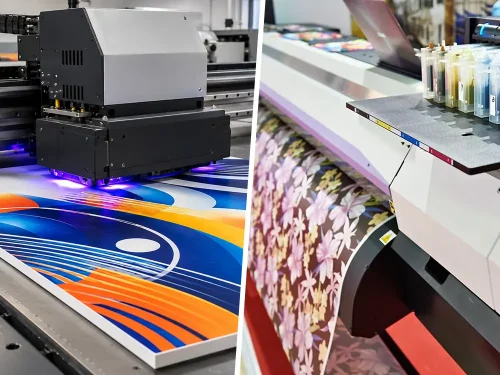
First, UV printing uses advanced printing machines. In this method, the printer head ejects ink onto the surface of the material. Then UV lights cure the ink; this curing happens almost immediately, hardening the ink on the material’s surface. This way, ink makes designs or prints that are very durable.
On the other hand, sublimation works differently as it does not use a printer. In this method, the design to be printed on the material is first made on the transfer paper. This design is made on paper using specialized sublimation ink. After that, the transfer paper with the design is placed against the material where the print is to be made.
Once done, the heat press applies heat to the design. As a result, the ink turns into gas when exposed to heat and penetrates the material. This ink embeds in the material and forms the print. The prints made using the sublimation method are also very durable and high quality. However, this method is limited to a few materials, such as fabrics (T-shirts, sportswear, and so on).
Differences Between UV Printing and Sublimation
There is no doubt that both UV printing and sublimation are well known for creating durable prints. However, they do this in different ways. This difference can greatly affect your choice. To make better decisions, let’s discuss their key differences and decide which truly stands out.
1- Printing Process & Technology
The first major difference lies in how each printing technique puts ink onto the product. Generally, UV printing is a direct printing method. The printer sprays UV ink straight onto the surface of the item. As the ink comes out, UV light cures, or hardens, it almost immediately. Sublimation takes a different route. It does not print directly onto the final material. The design is first printed on special sublimation paper. Heat and pressure then transfer the design onto the product. The heat turns the solid dye into a gas, which moves into the material. When it cools, the color stays inside the material.
2- Ink & Compatible Materials
Another clear variation between UV and sublimation is what type of ink each uses. If we discuss sublimation, it uses sublimation dye ink, which behaves differently. Heat turns the ink into a gas. This allows it to move into the material and not stay on top. But this works well only on materials that can accept the dye. On the other hand, UV printing uses special UV-curable ink. The ink stays on the product’s surface and is cured with UV light.
3- Color Quality & Appearance (White & Special Effects)
Both UV printing and sublimation produce bright and detailed designs. However, the final look differs. How? Actually, UV printing leaves a layer of ink on the surface. As a result, the colors look strong and clear. It also prints white ink, which is a big benefit when you are working on dark or transparent materials.
Further, UV printing gives you freedom in the print’s appearance. You can create effects such as glossy areas, raised textures, and different finishes. In contrast, sublimation has a different color quality. Its colors look very smooth and natural, especially on white or light-colored products. However, sublimation is not as flexible with white and dark colors. This means it works best only on white or light-colored products.
4- Ease of Use & Production Speed
When it comes to ease of use, sublimation and UV printing differ. In this regard, sublimation is slightly less convenient because it requires more steps. First, you print the design on special transfer paper. Then the paper is placed correctly on the product. Then heat and pressure transfer the design. These extra steps slow production for large batches. Conversely, UV printing is a direct process. You place the item on the printer, set up the design, and print it. The UV light cures the ink quickly. This means you can print several products in a short time, which means fast production speed.
5- Image Detail & Resolution
Suppose your main priority is sharp text, clear logos, and fine details; UV printing wins. It prints directly onto the product, so small lines, letters, and shapes come out very clean. This makes it a better choice when the design needs to look crisp and precise. Sublimation also produces detailed images, but its real strength is smooth and colorful artwork. However, sublimation is not designed for the same wide range of hard surfaces. It creates detailed prints only on soft surfaces.
6- Print Durability & Resistance to Scratches and Moisture
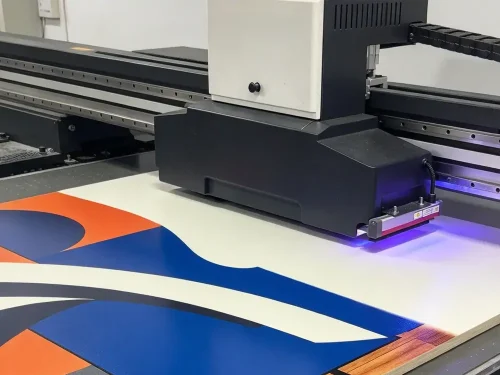
When it comes to hard surface durability, UV printing usually stands out. Why? The reason is its UV ink, which cures directly on the surface with UV light. This process creates a durable print layer. This print can withstand routine washes and scratches and doesn’t fade easily. Sublimation also produces durable designs, but only on polyester products. The dye moves into the material instead of forming a top layer. Because of this, there is no ink layer to peel or crack during normal washing. However, on hard surfaces, it does not guarantee durability.
7- Surface Requirements & Customization Flexibility
Lastly, surface needs and customization are another factor that sets sublimation and UV printing apart. In this term, sublimation is much more limited. It needs a material that can accept sublimation dye. Polyester fabric is the main choice. However, hard products need a special polyester coating. This means you cannot take any mug, piece of wood, or plastic item and sublimate a design onto it. Still, it offers customization for polyester.
On the other hand, UV printing has a main benefit in terms of surface requirements. It can print directly onto many surfaces, such as wood, acrylic, glass, metal, plastic, and other materials. You do not always need a special coating or transfer paper. Moreover, it offers more options for surfaces, products, colors, and special effects.
8- Cost & Idea Use Case
These two printing methods differ in terms of cost. UV printing is generally more costly than sublimation. Why? The reason is that UV printing involves a UV printer, UV-curable ink, and advanced curing technology. Both UV printers and UV-curable ink are expensive, which contributes to their higher cost.
However, this higher cost is worth it, as this printing method is very versatile. It allows you to create high-quality and bold prints on a wide range of materials. These include glass, plastics, metals, rubber, and more. In contrast, sublimation is a cost-effective way to create prints on materials. This is cost-effective because it does not require an advanced printer or costly inks.
However, this method is limited in material compatibility. You can print only on fabrics or other coated materials. Because of its wider material compatibility, people prefer UV printing despite its higher cost. Below is the table showing the best use case or application of these methods:
| UV Printing | Sublimation |
|---|---|
| Glass bottles | T-shirts |
| Acrylic signs | Sportswear |
| Phone cases | Mugs |
| Wood products | Tumblers |
| Metal products | Polyester fabrics |
| Promotional items | Flags & banners |
| Packaging | Personalized apparel |
Frequently Asked Questions
Is UV printing better than sublimation?
Yes. I consider UV printing better than sublimation. This method is more versatile, offers durable prints, and is very easy to use. Above all, you can use it to print on a wider range of materials.
What are the key differences between sublimation and UV printing?
UV printing uses UV printers, sprays ink on the surface, and uses UV lights to cure it. This method is compatible with a wide range of materials. Sublimation uses sublimation paper, dye, and heat to turn ink into gas. Heat turns the ink into gas, which penetrates the material to create prints on the surface.
What material is better for sublimation?
Materials that accept sublimation dye are best for the sublimation process. I recommend choosing polyester fabrics for sublimation. You can also use any product with a polyester or polymer coating on its surface. This coating accepts the ink, which makes printing possible.
Conclusion: Which One to Choose, UV Printing or Sublimation
UV printing and sublimation are two totally different printing choices. They use different inks and printing methods, as this guide explains. In case you want my opinion:
I recommend choosing UV printing in most cases. Why? This printing method is very versatile. You can create prints on different materials using this method. Above all, UV prints are higher quality and more durable. If you have a tight budget, you can choose sublimation. But this method only works with fabric or materials that accept sublimation dye.
In short, UV printing is the more flexible option. It prints directly on many hard surfaces and offers more customization. However, sublimation has a more specific strength. It works extremely well on polyester fabrics and specially coated products. In this article, I have discussed the fundamental differences between these two printing methods.
