

What is DTF Printing? A Complete Technical Guide
Direct-to-Film (DTF) printing is a digital textile printing process in which designs are printed onto a special PET (polyethene terephthalate) film using pigment-based inks, then transferred onto fabric using heat and pressure. Since its commercial adoption in the early 2020s, DTF has become one of the fastest-growing garment decoration technologies worldwide.
How DTF Printing Works
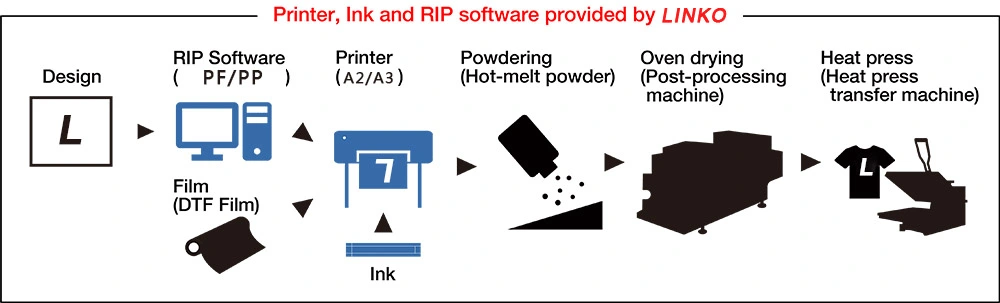
The DTF printing process involves five distinct steps:
Step 1 — Design Preparation The artwork is mirrored and colour-separated using RIP (Raster Image Processing) software such as PrintFactory, Maintop, or PhotoPrint. The software manages ink density, colour profiles, and white ink layering.
Step 2 — Printing onto PET Film The printer first lays down the CMYK colour layers, followed immediately by a white ink layer. The white ink acts as an opaque base, enabling vibrant colour reproduction on both light and dark fabrics. PET film thickness typically ranges from 75 to 120 microns.
Step 3 — Hot Melt Powder Application While the ink is still wet and tacky, thermoplastic polyurethane (TPU) hot melt powder is applied evenly across the printed surface. The powder acts as an adhesive between the ink and the fabric fibres. Excess powder is removed before curing.
Step 4 — Curing The powder-coated film passes through a curing oven or powder shaker unit at temperatures between 120–160°C (248–320°F) for approximately 2–3 minutes. This melts and bonds the powder to the ink layer, creating a ready-to-transfer film.
Step 5 — Heat Transfer The cured film is placed face-down on the target fabric and pressed using a heat press at 150–170°C (302–338°F) for 10–15 seconds under firm pressure. After pressing, the carrier film is peeled away — either hot or cold, depending on the film type — leaving the design permanently bonded to the fabric.
Equipment Required for DTF Printing
A complete DTF printing setup consists of the following components:
DTF Printer DTF printers are roll-to-roll inkjet systems equipped with pigment ink and white ink channels. Common printhead configurations include:
- Single or dual Epson XP600 heads (entry-level, A3–A1 format)
- Single to quad Epson i3200 heads (professional, A1–60cm+ format)
- Epson i1600 heads (industrial, high-speed production)
Print widths range from 33cm (A3) for desktop models to 60cm or wider for industrial roll-to-roll systems. All DTF printers require a white ink circulation system to prevent white ink sedimentation and printhead clogging.
Powder Shaker and Curing Unit: An integrated powder shaker automatically applies hot melt powder and cures the film in a single pass. Key specifications include conveyor belt speed, heating tunnel length, and cooling zone capacity. Automated units significantly reduce labour costs compared to manual powder application.
Heat Press Machine: A flat heat press with consistent platen pressure is required for the transfer stage. Clamshell and swing-away designs are both suitable. Recommended settings are 160–170°C, 10–15 seconds, medium-to-firm pressure, though optimal parameters vary by fabric type and film specification.
RIP Software RIP software manages colour management, white ink underlayer generation, and the print queue. Popular options include PrintFactory, Maintop, and PhotoPrint. Advanced RIP software can reduce ink consumption by up to 20% through optimized ink density profiles.
Consumables
- DTF Ink: Water-based pigment ink formulated for PET film adhesion, available in CMYK + White configurations
- PET Film: Available in hot-peel and cold-peel variants; transfer rate typically exceeds 99%
- Hot Melt Powder: TPU-based adhesive powder in fine (80–100 mesh) and coarse grades for different fabric textures
Compatible Materials
One of DTF printing’s key advantages over competing technologies is its broad material compatibility. DTF transfers can be applied to:
- Fabrics: Cotton, polyester, nylon, spandex, treated leather, 50/50 blended fabrics, both light and dark colours
- Hard surfaces: With appropriate adhesive film, DTF can transfer onto leather goods, shoes, bags, caps, and some rigid substrates
- No pre-treatment required: Unlike DTG printing, DTF does not require fabric pre-treatment (PTM), reducing preparation time and cost
Comparison with Other Textile Printing Methods
| Feature | DTF | DTG | Sublimation | Screen Printing |
|---|---|---|---|---|
| Fabric compatibility | Cotton, poly, blends, nylon | Primarily cotton | Polyester only (light) | Most fabrics |
| Pre-treatment required | No | Yes (for dark fabrics) | No | No |
| Minimum order quantity | 1 piece | 1 piece | 1 piece | 24–50+ pieces |
| Color limitation | None | None | None | Per screen |
| White ink capable | Yes | Yes | No | Yes |
| Wash durability | 50–100+ washes | 50–80 washes | 50+ washes | 50–100+ washes |
| Setup cost | Low–Medium | Medium–High | Low–Medium | High |
| Best for | Short runs, dark fabrics, mixed materials | Cotton on-demand | Polyester sportswear | High-volume uniform orders |
Applications
DTF printing is widely used in the following industries and applications:
- Custom apparel: T-shirts, hoodies, uniforms, sportswear, workwear
- Accessories: Hats, caps, bags, shoes, aprons, pillowcases
- Print-on-demand: Single-unit fulfillment for e-commerce brands
- Promotional merchandise: Corporate gifts, event merchandise
- Fashion and streetwear: Short-run collections with complex multicolor designs
Wash Durability and Print Quality
DTF prints using high-quality TPU hot melt powder and pigment ink achieve wash fastness ratings of Grade 4–5 (ISO 105-C06 standard), meaning the print withstands 50 to over 100 machine wash cycles without significant fading or cracking. The elasticity of the TPU adhesive layer allows the print to stretch with the fabric without cracking, making it suitable for activewear and fitted garments.
Health and Safety Considerations
DTF printing involves the use of fine thermoplastic powder during the application stage, which generates airborne particulates. Recommended safety measures include:
- Local exhaust ventilation (LEV) at the powder application station
- Respiratory protection (N95 or equivalent) when handling loose powder
- A smoke purifier or fume extractor connected to the curing oven to capture volatile organic compounds (VOCs) released during the heat-curing stage
- Adequate general ventilation in the printing workspace
These measures align with occupational health guidance from OSHA (29 CFR 1910.94) and equivalent regulatory bodies in other jurisdictions.
Industry Adoption
DTF printing gained commercial traction in the early 2020s as a more versatile alternative to DTG printing, particularly for operators working with polyester, blended, and dark-colored fabrics. The technology is now offered by major printing equipment manufacturers, including Epson, Mimaki, and numerous Chinese OEM manufacturers. DTF has been adopted by custom apparel businesses, print-on-demand platforms, and textile decoration service providers across North America, Europe, and Asia.
Explore LINKO’s full range of DTF printers, UV DTF printers, and DTF consumables, or contact us for a customized printing solution.
